Energy Balance
The Quiet Arithmetic of Energy Balance in Everyday Eating
Eleanor Whitfield
·

Eating Patterns
Most people are aware, in a general sense, that ultra-processed foods are not nutritionally optimal. Fewer consider the more specific question: not what these foods contain, but what they do to the appetite signals that govern eating across the remainder of the day and into the following morning.
01 — Defining the Category
The NOVA classification system, developed at the University of São Paulo, categorises foods not by nutrient content but by the degree and purpose of processing. Ultra-processed foods — NOVA Group 4 — are defined as industrial formulations that combine extracted food substances with additives, and that are designed to be highly palatable, convenient, and energy-dense.
What this classification captures is something that traditional nutrient analysis misses: the structural transformation of food. A whole oat grain and an oat-based processed snack bar may share similar macronutrient profiles. They behave very differently in the digestive system, producing different glucose absorption rates, different fibre fermentation profiles, and different satiety signal durations.
The practical importance of this distinction is that processed food awareness cannot be reduced to reading a nutrition label. It requires a broader understanding of how the structural form of food — not just its nutrient content — shapes the body's experience of eating and the subsequent pattern of appetite.
02 — Appetite Override
A body of research, including a controlled study conducted at the National Institutes of Health in the United States, has shown that people consuming predominantly ultra-processed diets consume meaningfully more energy per day than those consuming whole food alternatives — even when the two diets are matched for energy, sugar, fat, and fibre availability and presented to participants without restriction.
The mechanism appears to involve eating rate and the temporal dynamics of satiety signalling. Ultra-processed foods tend to require less chewing, are consumed more rapidly, and deliver energy to the bloodstream more quickly than minimally processed alternatives. Satiety signals, which require time to develop and register, are therefore generated after more energy has already been consumed than would be the case with slower-digesting whole food alternatives.
This is not a failure of willpower or attention. It is a structural feature of how ultra-processed formats are designed — one that has consequences for the appetite signals that govern eating throughout the remainder of the day.
“The disruption is not to a single meal but to the appetite pattern that follows it — measured across days, not minutes.”
Harriet Caldwell — Olemi Field Notes
03 — Portion Signals
The body's portion signals — the internal cues that indicate sufficient intake — depend in part on the physical characteristics of food. Volume, weight, texture, and chewing effort all contribute to the cues that precede and accompany satiety. Ultra-processed foods are often energy-dense relative to their volume and physical mass, meaning the sensory signals associated with sufficient intake arrive well before an adequate energy intake has been reached.
This is why portion perspective — the mindful awareness of how much is being eaten — is substantially harder to apply when the foods being eaten are highly processed. The portion signals themselves are less reliable, because the usual relationship between food volume, eating duration, and energy content has been altered by processing.
Mindful portion habits are most effective when applied to whole or minimally processed foods, where the body's natural appetite and satiety signalling systems are operating in their full range. This is not an argument for restriction, but for composition: the more whole food content a meal contains, the more accurately the body can gauge its own intake.

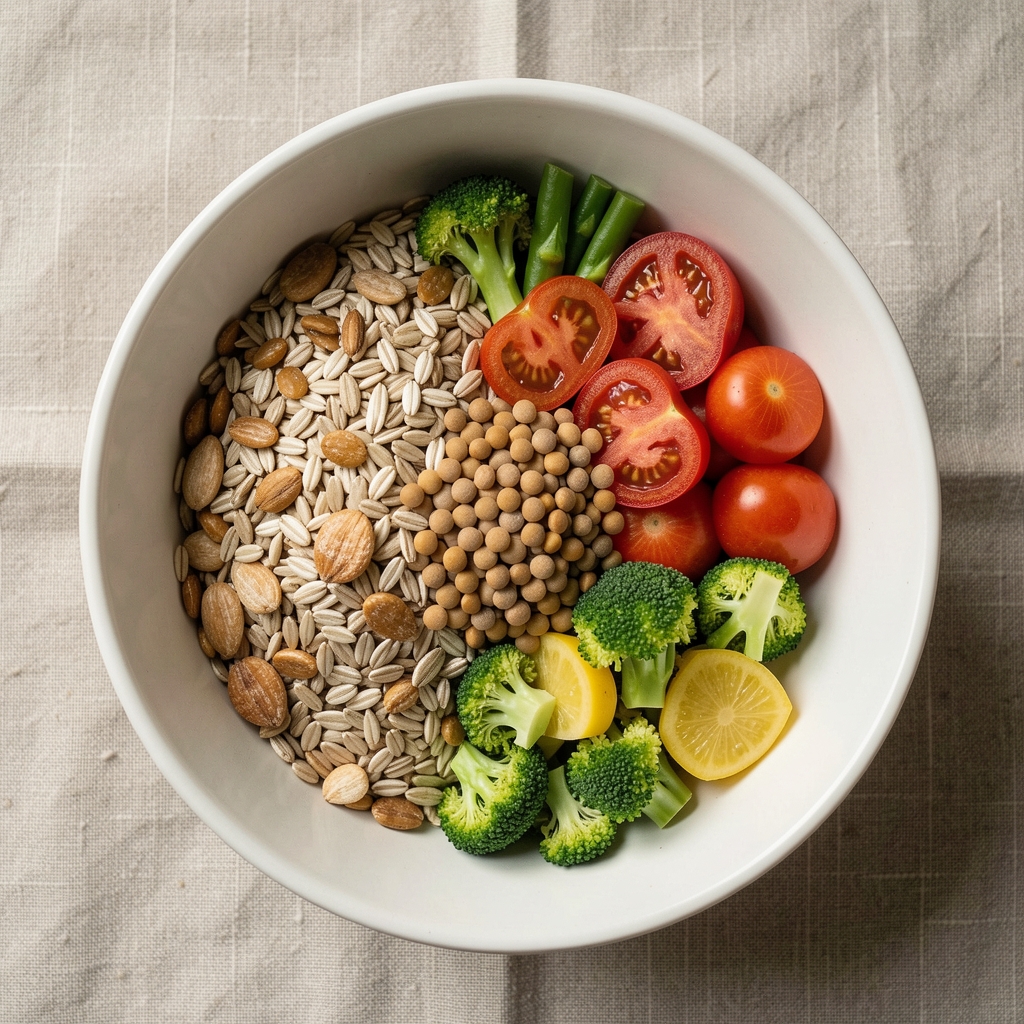
Fig. 03-B · Whole food versus ultra-processed breakfast compositions — structural contrast · Olemi Field Notes archive
Key Observations
04 — The Rhythm Effect
The rhythmic quality of a stable eating pattern — the predictability of hunger onset, meal timing, and appetite strength — is one of the characteristics that distinguishes those who maintain a consistent body weight over years from those whose weight fluctuates. Ultra-processed food consumption appears to introduce noise into this rhythm in ways that persist across the following day or two.
Higher energy intake on a given day, driven by the appetite override properties of ultra-processed foods, tends to be followed by disrupted appetite signals the following morning — rather than the compensatory reduced appetite that might be expected. The usual mechanism of appetite compensation appears to be blunted or delayed following high ultra-processed intake, contributing to a pattern of persistently elevated energy consumption across successive days.
The implication is that individual meals containing ultra-processed foods should be considered in the context of what they do to the following day's appetite, not only to the meal at hand. A pattern of regular ultra-processed consumption does not merely add energy at each sitting; it gradually erodes the body's capacity to regulate appetite in the days that follow.
05 — Mindful Portion Habits
The category of ultra-processed foods is broad and partly overlaps with what people regard as ordinary, familiar food. Bread, crackers, breakfast cereals, flavoured yogurts, ready-made sauces, and many snack products fall within this category. An awareness of this does not require the elimination of any of these foods from the diet — it requires a shift in how they are regarded within the overall structure of eating.
Mindful portion habits — the practice of bringing genuine attention to what and how much is being eaten — are most usefully applied at the level of the day's overall composition rather than at the level of individual items. A day in which the majority of meals draw from whole food sources, with ultra-processed items present but not dominant, tends to preserve the rhythmic quality of appetite that supports stable energy intake across the week.
This is not a demand for dietary perfection. It is an observation, drawn from the evidence base, about what tends to preserve the body's natural appetite rhythm and what tends to disrupt it. The weekly eating rhythm — the accumulated record of ordinary daily choices — is where body composition is ultimately written.
Editorial Notice
Articles published on Olemi Field Notes are editorial in nature and reflect the writers' observations on everyday wellness practices. The content is not intended as professional advice, nor as guidance for the management of any specific condition. Readers with specific concerns about their daily routines are encouraged to speak with a qualified wellness professional.

About the Author
Harriet Caldwell
Harriet Caldwell is a guest contributor to Olemi Field Notes. Her writing examines how food processing and structural format affect appetite and eating patterns, drawing on a background in nutritional anthropology and long-form editorial journalism.
More from this publication →Related Reading